Christmas is often associated with celebration, colour, and noise. Yet when Scripture itself tells the Christmas story, it does so quietly. The birth of Jesus is announced with angels to unsuspecting shepherds, but the recognition of who he truly is comes through something far less dramatic: faithful waiting.
Introduction: The Power of Waiting
We live in an age that hates waiting.
We want instant answers, instant results, instant fulfilment. If something takes too long, we assume it isn’t worth having.
But Scripture tells a very different story.
Some of God’s greatest servants are not remembered for what they built or conquered – but for what they waited for. And in Luke chapter 2, we meet two such people:
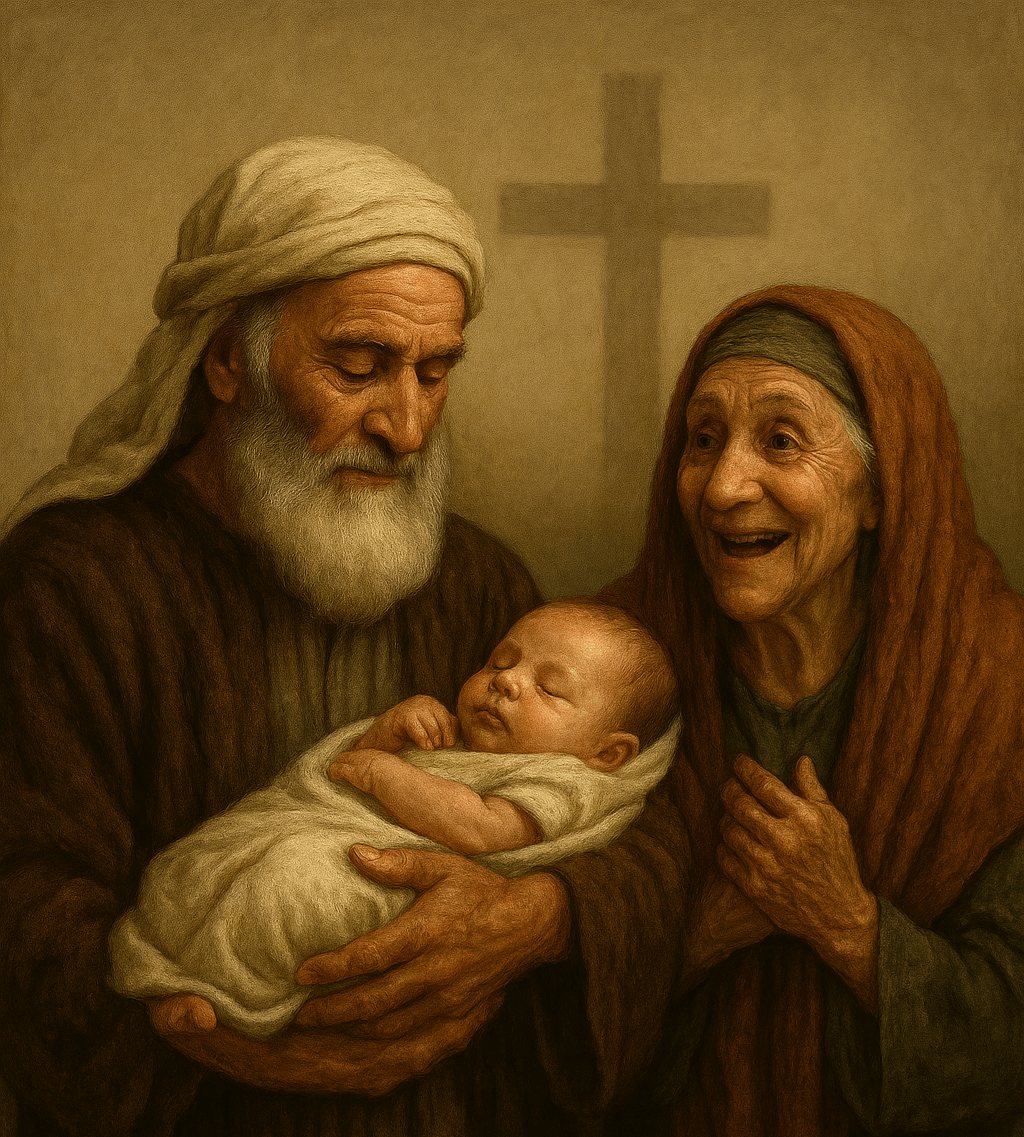
Simeon and Anna – aged believers, faithful through the decades of silence, whose lives had been shaped by hope in the promises of God. They were not rulers, priests, or scholars. They held no authority and commanded no attention. Yet they were among the first to truly understand what the birth of Jesus really meant.
Their story invites us to recover the true, biblical meaning of Christmas.
A Child Born Under the Law (Luke 2:22-38)
When Mary and Joseph bring the 40-day old infant Jesus to the temple, Luke is careful to emphasize obedience to the Law of Moses. Jesus is presented as the firstborn, and an offering is made according to Leviticus— “a pair of turtledoves, or two young pigeons,” the provision for the poor.
This matters. From the very beginning, Jesus is shown to be fully human, born of a woman, born under the Law, sharing the condition of those he came to save (Galatians 4:4–5). He is not presented as a divine being visiting humanity, but as a child of Israel, born of a woman, subject to God’s law, and raised within it. This aligns with the biblical understanding of Jesus as the Son of God by birth and purpose, yet fully partaking of human nature (Hebrews 2:14).
The Redeemer of the world enters the temple not as a king, but as a poor child – partaking in the same mortal nature as those he came to deliver – according to the Law. This is no contradiction—it is essential to the gospel (Hebrews 2:17; 4:15; 5:7-9; Acts 2:24).
Simeon and the Hope of Israel
Simeon is described as “just and devout, waiting for the consolation of Israel.” This phrase reaches directly into the words of Isaiah, who spoke of comfort, forgiveness, and restoration for God’s people. Simeon’s hope is not vague or mystical; it is rooted in Scripture:
“Comfort ye, comfort ye my people, saith your God.” (Isaiah 40:1)
He is waiting for the fulfilment of the promises made to Abraham, Isaac, Jacob, and David—promises of forgiveness, restoration, and a coming king. Like many faithful Israelites, Simeon understood that God’s purposes would be worked out through a Messiah raised up from among the people of Israel (Deuteronomy 18:15; Acts 3:22–23)
When Simeon takes the child Jesus in his arms and declares, “Mine eyes have seen thy salvation,” he is not saying that salvation has been completed, but that it has now been revealed. The means by which God will save is now present – and he’s holding him – like an anchor for the soul! (Hebrews 6:19)
This is an important distinction. Salvation was not achieved at the birth of Jesus, but through his life of obedience, culminating in his death and resurrection. Simeon sees the beginning of that saving work—the one through whom God will accomplish His purpose (2 Corinthians 5:18-19).
A Light to the Gentiles
Simeon’s words draw heavily from Isaiah: Jesus will be “a light to lighten the Gentiles, and the glory of thy people Israel” (Isaiah 42:6; 49:6). This shows that the gospel was never intended to be restricted to Israel alone. From the beginning, God’s purpose included all nations.
Yet notice the order: Israel comes first. Jesus is the glory of Israel because the promises were entrusted to his forefathers – the Patriarchs – and because the Messiah arises from among them – the promised seed. Only through Israel’s Messiah does light reach the Gentiles. This reflects the biblical pattern found in the promises to Abraham:
“In thy seed shall all nations of the earth be blessed.” (Genesis 12:3)
Christmas, then, is not about sentiment, but about promise and fulfilment. It marks the arrival of the promised “seed” through whom God will bring blessing, forgiveness, and ultimately a restored earth under righteous rule.
A Child Appointed for Division
Simeon also delivers a sobering message. This child, he says, is set for the falling and rising of many in Israel. Jesus will not simply unite people—he will reveal hearts. Some will rise in faith and humility; others will stumble through pride and unbelief.
This fits the wider gospel message. Jesus did not come to confirm existing religious comfort. He came to call people to repentance, obedience, and faith in God’s promises. Christmas cannot be separated from the challenge of discipleship. The Messiah was to suffer and be rejected – we follow his steps.
Simeon’s words to Mary—that a sword would pierce her own soul—remind us that the joy of Christmas leads inevitably to the suffering of the cross. The birth of Jesus cannot be understood apart from his death. The manger already points forward to the sacrifice on the cross that would make salvation possible.
Anna and the Hope of Redemption
Anna’s story is quieter still, but no less powerful. A widow for most of her long life, she remained in the temple, serving God with prayer and fasting. Her faith is marked by endurance. She waits through years when nothing seems to change, yet she does not abandon hope.
When she sees the child, she gives thanks to God and speaks of him to all who were “looking for redemption in Jerusalem.” That phrase again echoes Isaiah, who spoke of Jerusalem’s redemption and restoration:
“Break forth into joy… for the LORD hath comforted his people, he hath redeemed Jerusalem.” (Isaiah 52:9)
Anna understands that redemption is not merely personal—it is national and global. It is tied to the future restoration of Israel and the coming Kingdom of God on earth. This aligns with the hope of a restored earth under Christ’s reign, when Jerusalem will again be the centre of divine rule.
What Simeon and Anna Teach Us Today
Simeon and Anna recognised Jesus because they were watching for God’s promises to be fulfilled. They were shaped by Scripture, sustained by hope, and willing to wait.
In a world where the hope of a coming Messiah has become increasingly detached from its biblical roots, their example calls us back to first principles. Christmas is not about tradition or nostalgia. It is about God keeping His word.
It reminds us that Jesus is the promised Messiah, fully human, raised up by God, who through obedience and sacrifice opened the way to forgiveness and life. It points forward to the future fulfilment of God’s purpose in the Kingdom, when Christ will return to reign on the earth and bring true and lasting peace.
Like Simeon, we wait—not now for the first coming, but for the second. And like Anna, we are called to speak of redemption to others who are searching for hope.
Christmas, rightly understood, strengthens our faith and our preaching. It reminds us that God works patiently, faithfully, and according to His word—and that those who wait upon the Lord will not be disappointed.
Lessons for Us Today
1. God Rewards Faithful Waiting
Neither Simeon nor Anna rushed God.
They stayed faithful when nothing seemed to be happening.
And in the end, they saw what kings and prophets longed to see, and many in their day missed completely.
2. Spiritual Sight Matters More Than Position
The priests missed Him.
The scholars missed Him.
But the faithful watchers saw Him.
Faith sees what the natural eyes cannot.
3. Jesus Is Both Comfort and Conflict
Simeon tells us plainly:
This child brings salvation — but also division.
The gospel always reveals hearts – some will rise, others will fall.
4. God Uses the Faithful, Not the Famous
Anna never left the temple courts.
But her words echo into eternity.
Faithfulness matters.
Simeon was ready to die — because he had seen the promised Messiah.
Anna was ready to speak — because she had seen redemption.
What About Us?
As we gather today for Christmas, surrounded by familiar songs and cherished traditions, the witness of Simeon and Anna asks us a gentle question:
Are we still waiting?
Are we still watching?
Or have we become so accustomed to Christmas that we no longer recognise Christ when He comes quietly into our lives?
May we learn again the true spirit of Christmas — not haste, but hope; not noise, but patient waiting – faith; for us that means waiting for Jesus to return.
And may we, like Simeon, be able to say with peace in our hearts and light in our eyes:
“My eyes have seen your salvation.”
Amen. Even so come Lord Jesus.




 The Original Gospel
Leave a comment