
- Critics of the Bible
- The Purpose of God
- Overview of the Books of the Bible (Part 4)
- Study Tools (Part 2) Versions of the Bible
| Critics of the Bible |
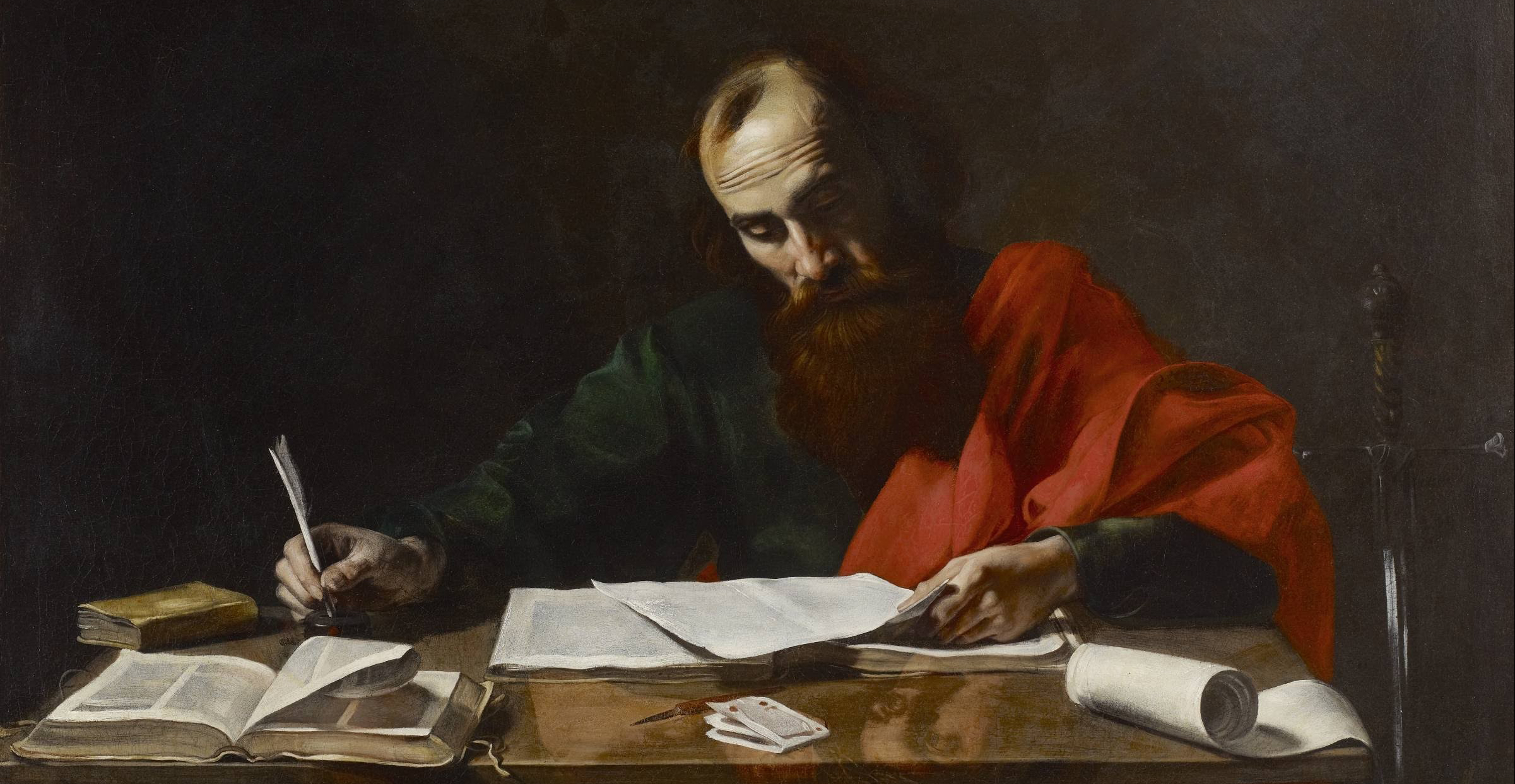
We cannot be students of the Bible without recognizing the fact that such a book, one which claims Divine inspiration, is continually being attacked by all types of critics to its claims. We acknowledge this, and though the scope of this class is not aimed at proving the critics wrong, we have attempted to summarize a few of the most often cited criticisms of the Bible.
CRITICISM #1: The Bible is an ancient document written by primitive men who were only trying to force their will on others by claiming a book of divine origin. This makes the Bible nothing more than a compilation of crude facts, fiction, folklore, and legend.
This criticism is disproved by:
‑ Archaeology
‑ Geology
‑ History
CRITICISM #2: The Claim of the Bible to be an inspired revelation is an out-of-date concept in the light of “scientific” progress. Moreover, the predictions made in the Bible could have occurred due to coincidence or natural phenomena.
This criticism is disproved by:
– Prophesy
– Fair application of scientific methods and principles
CRITICISM #3: Even if the Bible were originally the inspired Word of God, languages, constant revision, etc., would remove any hope of using the Bible as a standard of life for all of mankind.
This criticism is disproved by:
Bibliographical Test
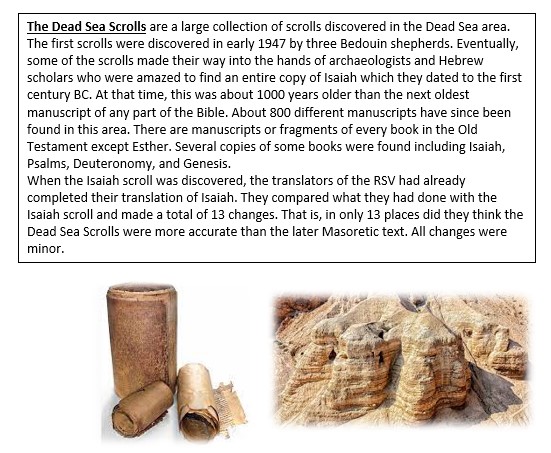
Dead Sea Scrolls
| Author | Written | Earliest Copy | Time Span (Years) | Number of Copies |
| Caesar | 100-44 BC | AD 900 | 1000 | 10 |
| Plato | 427-347 BC | AD 900 | 1200 | 7 |
| Herodotus | 480-425 BC | AD 900 | 1300 | 8 |
| Aristotle | 384-322 BC | AD 1100 | 1400 | 49 |
| Homer | 900 BC | 400 BC | 500 | 643 |
| New Testament | AD 40-100 | AD 125 | 25 | over 24000 |
CRITICISM #4: If the men who wrote the Bible were inspired by God, why are there different accounts of the same event? Should not the accounts recorded be identical and not in seeming contradiction?
This criticism is disproved by:
‑ Harmony of Facts
– Consistent Message
– Different Accounts actually give credibility
– Proximity to Events

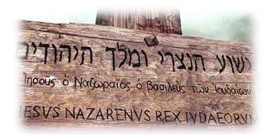
| Matthew 27:37 | This is | Jesus | the King of the Jews. |
| Mark 15:26 | The King of the Jews. | ||
| Luke 23:38 | This is | the King of the Jews. | |
| John 19:19 | Jesus of Nazareth | the King of the Jews. |
Does each writer have to record everything?
Is it not likely that the sign said: “This is Jesus of Nazareth, the King of the Jews”?
Perspectives Are Different Than Contradictions
“Sometimes when we read parallel accounts of the same event we seem to find minor contradictions in the way the event is described. We’ve got to be careful not to confuse differences in perspective with Biblical “error”. Remember, no two witnesses to the same event will ever describe the event in exactly the same way. If the witnesses did describe the event in exactly the same way, you would probably question their honesty. The original assemblers of the Scriptures could easily have changed the differing accounts after the fact so they all said the same thing. Or they could simply have formed one large Gospel including a single story of Jesus, and then destroyed all the competing accounts. But that’s not what they did. Instead, they left us with all four eyewitness accounts so we could get all the differing perspectives. These differences are not the result of error; they are simply the result of perspective.”
(J. Warner Wallace, Cold-Case Christianity)
| The Purpose of God Revealed |
WHY DID GOD CREATE MAN?
We often ask the question, “What was the divine motive? Why did God create the earth and its inhabitants?
God revealed his purpose to Moses in Numbers 14:21
“But as truly as I live, all the earth shall be filled with the glory of the Lord. “
Creation was for God’s glory and honor.
“You are worthy, our Lord and God, to receive glory and honor and power: for you created all things, and by your will they existed and were created. ” (Rev. 4:11, NRSV)
The earth was created to be inhabited according to Isaiah 45:18:
“For thus saith the LORD that created the heavens; God himself that formed the earth and made it; he hath established it, he created it not in vain, he formed it to be inhabited: I am the LORD; and there is none else.”

From these few verses we learn:
l. God created the earth to be inhabited
2. Those inhabitants are created for the glory of God.
3. His purpose involves filling the earth with His glory
WHAT IS GOD’S GLORY?
How does one define glory?
In the simplest but perhaps most complete terms:
God = glory = righteousness, love, truth, wisdom
Hence, to fill the earth with his glory is to fill it with his character, ways and thoughts. To manifest God is to show His glory.
Manifestation is defined as “to reveal or make known.”
PURPOSE OF GOD REVEALED IN HIS MEMORIAL NAME
Note in Isaiah: 45:18 (previous page) ” I am the LORD ”
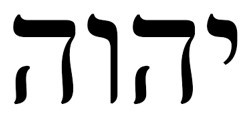
LORD, Capitalized in KJV, RSV, etc. Actually the word Yahweh. In the Hebrew meaning, “I will be who I will be.”
The name of God was revealed to Moses in the incident of the burning bush:
Moses said to God, “Suppose I go to the Israelites and say to them, ‘the God of your fathers has sent me to you,’ and they ask me, ‘What is his name? ‘ Then what shall I tell them? ” God said to Moses “I AM WHO I AM. This is what you are to say to the Israelites. I AM has sent me to you.” (Exodus 3:13‑14 NIV)

God was revealed in the burning bush.
Whose superscription? We are in the image of God. (Gen. 1:26) As children reflect (or manifest) the qualities of their parents, so we must learn to reflect the glory of God by assuming His character. This was the case in Christ which is why he could say, “He who hath seen me hath seen the Father.” (John 14:9)
As you read the Scriptures, pay attention to how many times the “Name” is referred to. Consider the Lord’s prayer, “Our Father, Hallowed be thy Name.” (Matthew 6:9)
Names are given great importance in scripture. “Thou shalt call his name… ” (Matt. 1:21) They are to reveal the purpose of the person. So it is true with God.
SUMMARY
We are created in God’s image and for His glory. His desire is satisfied in a creation who willingly chooses to manifest His own thoughts and ways. As of yet, this has only been perfectly accomplished in his son, the Lord Jesus Christ, but God’s purpose to completely fill the earth with his glory cannot be thwarted.
| Overview of the Books of the Bible (Part 4) |
Zephaniah
Author: Zephaniah
Time: 635- 615 B.C.
Summary: Zephaniah prophesied during King Josiah’s reign. He was responsible for a great religious reform. This reform followed the wicked reigns of Kings Manasseh and Amon, who led the nation into various forms of idolatry. Zephaniah pronounces inescapable judgments against Jerusalem for their sins and exhorts national repentance. He further speaks of the “day of the LORD “, when God will intervene to judge sin.
INTRODUCTION ‑ Chapter 1:1
A WARNING OF IMPENDING JUDGMENT‑ Chapter 1:2‑18
1. The judgment announced ‑ Ch. 1:2‑6
2. The judgment defined ‑ Ch. 1:7‑13
3. The judgment described ‑ Ch. 1:14-18
AN EXHORTATION TO IMMEDIATE REPENTANCE‑ Chapter 2:1 ‑ 3:8
1. An invitation to repentance ‑ Ch. 2:1‑3
2. A detailed warning of judgment‑ Ch. 2:4-3:8
A PROMISE OF FUTURE BLESSING ‑ Chapter 3:9‑20
1. The promise of conversion ‑ Ch. 3:9‑13
2. The promise of restoration ‑ Ch. 3:14-20
Jeremiah
Author: Jeremiah and Baruch
Time: 630‑575 B.C.
Summary: Jeremiah warns of the impending military force of Babylon that would destroy Jerusalem and enslave the Jews. He urges Jerusalem to turn from its wicked ways, but there is no response. He further warns of the false prophets who are leading the people astray with deceptive doctrines and falsehoods. He urges the Israelites to submit to the Babylonian authority as the instrument of God’s judgment. They do not heed his warnings and the people are carried away to Babylon. He predicts that the captives will return after 70 years to rebuild Jerusalem and the Temple.
INTRODUCTION: THE PROPHET’S CALL‑ Chapter 1:1‑19
PROPHETIC ORACLES AGAINST JERUSALEM AND JUDAH ‑ Chapter 2:1‑45:5
1. In the reign of Josiah and Johoiakim ‑ Ch. 2:1 ‑ 20:18
2. Various Periods until Jerusalem’s Destruction ‑ Ch. 21:1‑ 39:18
3. After the Fall of Jerusalem ‑ Ch. 40:1 ‑ 45:5
PROPHECIES AGAINST THE NATIONS ‑ Chapter 46:1 ‑ 51:64
1. Against Egypt‑ Ch. 46:1‑28
2. Against Philistia ‑ Ch. 47:1‑7
3. Against Moab ‑ Ch. 48:1‑47
4. Against Ammon ‑ Ch. 49:1‑6
5. Against Edom‑ Ch. 49:7‑22
6. Against Damascus ‑ Ch. 49:23‑27
7. Against Arabia ‑ Ch. 49:28‑33
8. Against Elam‑ Ch. 49:34-39
9. Against Babylon ‑ Ch. 50:1 ‑ 51:64
HISTORICAL APPENDIX ‑ Chapter 52:1‑34
1. Judah’s Fall and Captivity‑ Ch. 52:1‑30
2. Jehoiachin’s liberation ‑ Ch. 52:31‑34
Habakkuk
Author: Habakkuk
Time: 620-605 B.C.
Summary: The book begins with Habakkuk complaining of injustice in Judah and his inability to understand God’s failure to judge the wicked and morally deprived nation of Babylon. Habakkuk is shown that God’s people must continue to trust in His mercy regardless of the circumstances about them. The wicked appear to prosper while the righteous are chastened. However, this prosperity of the wicked is only temporary. God will not abandon those who obey and follow His commandments: “The just shall live by faith. ” (Cp. Psalm 73)
INTRODUCTION ‑ Ch. 1: 1
THE PROPHET’S COMPLAINT OF UNCHECKED VIOLENCE IN JUDAH ‑ Ch. 1:2‑4
THE LORD’S ANSWER: THE CHALDEAN IS HIS INSTRUMENT OF PUNISHMENT‑ Ch. 1:5‑11
A SECOND PROBLEM: THE CHALDEANS ARE MORE WICKED THAN THE JUDEANS ‑ Ch. 1:12 ‑ 2:1
THE LORD’S SECOND ANSWER: THE PURPOSE IS CERTAIN, AND FAITH WILL BE REWARDED ‑ Ch. 2:2‑4
FIVE WOES UPON INIQUITY, WHETHER JEWISH OR CHALDEAN ‑ Ch. 2:5‑20
A VISION OF DIVINE JUDGMENT ‑ Ch. 3:1‑16
THE TRIUMPH OF FAITH ‑ Ch. 3:17‑19
Lamentations
Author: Jeremiah
Time: 580 B.C.
Summary: Lamentation means “to express suffering”. In this book, Jeremiah expressed his sorrow regarding the fall of Jerusalem and the captivity of the nation at the hands of Nebuchadnezzar’s army. The book describes and explains the afflictions brought against the city of Jerusalem as well as surrounding nations who scoff at Jerusalem’s affliction. He emphasizes that this is the result of divine judgment for the sins of the people. The book further underlines lessons that Jerusalem should learn from to its afflictions, namely the vanity of glory, leadership, and pride in an attempt to overcome them in the future.
THE SUFFERING, RUINED CITY OF ZION ‑ Chapter 1:1‑22
1. Wretched condition of devastated Jerusalem ‑ Ch. 1:1‑11
2. Lament of the daughter of Jerusalem ‑ Ch. 1:12‑22
THE SUFFERING, RUINED HOLY PLACE OF ZION ‑ Chapter 2:1‑22
1. God’s judgments upon the ramparts and upon his sanctuary‑ Ch. 2:1‑10
2. Lament of the eyewitness of this judgment‑ Ch. 2:11‑19
3. Terrors of this day of God’s anger ‑ Ch. 2:20‑22
THE SUFFERING REPRESENTATIVE OF SMITTEN ZION ‑ Chapter 3:1‑66
1. The sorrows God sent his servant‑ Ch. 3:1‑18
2. The servant’s prayer of reassurance ‑ Ch. 3:19‑42
3. The servant’s prayer for vindication ‑ Ch. 3:43‑66
THE SUFFERING PEOPLE OF ZION ‑ Chapter 4:1‑22
1. Horrors of the siege, and the sad fate of Zion’s nobility‑ Ch. 4:1‑11
2. Causes and climax of Zion’s catastrophe ‑ Ch. 4:12‑20
3. A prophecy against haughty and gloating Edom ‑ Ch. 4:21‑22
SUPPLICATIONS OF PENITENT ZION ‑ Chapter 5:1‑22
1. Zion’s plea to God to regard her affliction and disgrace ‑ Ch. 5:1‑18
2. A final address to the eternal Sovereign ‑ Ch. 5:19‑22
Joel
Author: Joel
Time: 618-608 B.C.
Summary: The book of Joel begins by describing a devastating swarm of locusts which cause national disaster to the agriculture of Israel. Joel calls the nation of Judah to a day of repentance due to the Divine Judgment. The last portion of the book is concerned with events associated with the “Day of the Lord”. The message illustrated is that if Judah repents, God will richly bless them and forgive them.
THE LOCUST PLAGUE AS THE HARBINGER OF THE DAY OF THE LORD ‑ Chapter 1:2 ‑ 2:17
1. A threefold calamity: locusts, drought, and fires ‑ Ch. 1:2‑20
2. The scourge as the forerunner of the judgment day ‑ Ch. 2:1‑17
THE AVERTING OF JUDGMENT AND BESTOWAL OF BLESSINGS ‑ Chapter 2:18 ‑ 3:21
1. The blessings in the immediate future ‑ Ch. 2:18‑27
2. The outpouring of the divine Spirit‑ Ch. 2:28‑32
3. Judgment upon the nations ‑ Ch. 3:1‑16
4. The blessings on God’s people ‑ Ch. 3:17‑21
Daniel
Author: Daniel
Time: 605-535 B.C.
Summary: The book of Daniel predicts the destiny of two opposing powers: The Kingdom of Men and The Kingdom of God, stressing that “The most high rules in the kingdom of men”. Daniel’s prophecies generally do not deal with Israel as much as with the nations that control Israel. The book of Daniel contains prophecies that span the time from Daniel’s day until the coming Kingdom Age.
THE UNIVERSAL SOVEREIGNTY OF GOD ‑ AS REVEALED THROUGH PERSONAL EXPERIENCE ‑ Chapter 1 :1‑ 6:28
1. Human Learning Judged ‑ Ch. 1:1‑21
2. Human Philosophy Judged ‑ Ch. 2:1‑49
3. Human Worship Judged ‑ Ch. 3:1‑30
4. Human Pride Judged ‑ Ch. 4:1-37
5. Human Impiety Judged ‑ Ch. 5:1‑31
6. Human Oppression Judged ‑ Ch. 6:1‑28
THE UNIVERSAL SOVEREIGNTY OF GOD ‑ AS REVEALED BY PROPHETIC REVELATION ‑ Ch. 7:1‑ 12:13
1. Judgment on the Western Dominion ‑ Ch. 7:1‑28
2. Judgment on the Eastern Dominion ‑ Ch. 8:1‑27
3. Judgment on Israel After the Flesh ‑ Ch. 9:1‑27
4. Judgment on Israel After the Spirit ‑ Ch. 10:1‑21
5. Judgment on the Oppressors of the Land ‑ Ch. 11:1‑45
6. Judgment on the Oppressors of the People ‑ Ch. 12:1‑13
Ezekiel
Author: Ezekiel
Time: 593-560 B.C.
Summary: This book records the activity of the prophet Ezekiel during the exile in Babylon. His message was directed to fellow captives and to Jews still present in Palestine. Both groups refuse to listen and remain unwilling to accept the rule of Babylon. Ezekiel proclaimed good news to the exiles that Israel, after being chastened, would be restored and God’s Kingdom would rise. This yet future Kingdom will last forever and God’s people will never again be cast out.
PROPHECIES AGAINST JUDAH AND JERUSALEM ‑ Chapter 1:1 ‑ 24:27
1. Introduction: The call of Ezekiel ‑ Ch. 1:1 ‑ 3:27
2. Overthrow of city and state predicted ‑ Ch. 4:1 ‑ 7:27
3. The sin and fate of Jerusalem ‑ Ch. 8:1 ‑ 11:25
4. Moral necessity of the captivity‑ Ch. 12:1 ‑19:14
5. Israel’s coming downfall inevitable and necessary‑ Ch. 20:1 ‑ 24:27
ORACLES AGAINST FOREIGN NATIONS: THE UNIVERSAL SOVEREIGNTY OF GOD –
Chapter 25:1 ‑ 32:32
1. Ammon‑ Ch. 25:1‑7
2. Moab ‑ Ch. 25:8‑11
3. Edom‑ Ch. 25:12‑14
4. Philistines ‑ Ch. 25:15‑17
5. Tyre ‑ Ch. 26:1 ‑ 28:19
6. Sidon ‑ Ch. 28:20‑26
7. Egypt‑ Ch. 29:1 ‑ 32:32
PROPHECIES OF THE RESTITUTION OF ISRAEL ‑ Chapter 33:1 ‑ 39:29
1. The prophet: His function in preparation for the new age ‑ Ch. 33:1‑33
2. The royal house: The selfish shepherds of Israel and the Good Shepherd ‑
Ch. 34:1‑31
3. The land: Israel to be restored and made fruitful ‑ Ch. 35:1 ‑ 36:38
4. The people: Resurrection of the dry bones of Israel; reunion of Judah and Israel ‑ Ch. 37:1‑28
5. Peace: The Lord to defend Israel against Gog’s invasion ‑ Ch. 38:1 ‑ 39:29
VISION OF THE RESTORED COMMUNITY: THE NEW TEMPLE AND THE NEW LAW –
Chapter 40:1 ‑ 48:35
1. Description of the new Temple ‑ Ch. 40:1 ‑ 43:27
2. A new service of worship with an ideal ministry and sacrificial system ‑ Ch. 44:1 ‑ 46:24
3. Israel reorganized according to tribal divisions ‑ Ch. 47:1 ‑ 48:35
Obadiah
Author: Obadiah
Time: 585-565 B.C.
Summary: Obadiah, whose name means “servant of Yahweh”, was a prophet that pronounced judgment upon the nation of Edom for its antagonism against Israel. Edom is the nation that is descended from Esau, the twin brother of Jacob (Israel). Edom was to be punished for the violence against Israel they committed when invading the land.
TITLE AND INTRODUCTIONS ‑ Verse 1
JUDGMENT AND EDOM‑ Verse 2‑14
THE DAY OF THE LORD ‑ Verses 15‑21
Ezra
Author: Ezra
Time: 538-516 B.C.
Summary: In general, Ezra covers the events of the Jews returning from the Babylonian captivity. The decline of Babylon and its eventual overthrow by the Persians expedited this returning to Jerusalem. The Jews are numbered and are allowed to return to Judah to rebuild the Temple. Samaritan assistance is rejected and their opposition is a contributing factor to the slow progress of the Temple construction. Despite the delays, the Temple is completed and dedicated during this period.
THE EXILES’ RETURN FROM BABYLON ‑ Chapter 1:1 ‑ 2:70
1. The decree of Cyrus ‑ Ch. 1:1‑4
2. Preparations for the journey‑ Ch. 1:5‑11
3. Those who returned ‑ Ch. 2:1‑70
TEMPLE BUILDING BEGINS ‑ Chapter 3:1 ‑ 4:24
1. The altar and the foundation‑ Ch. 3:1‑13
2. Opposition to the work‑ Ch. 4:1‑24
THE BUILDING COMPLETED ‑ Chapter 5:1‑ 6:22
1.. Work resumed ‑ Ch. 5:1‑5
2. Tatnai’s letter to Darius ‑ Ch. 5:6-17
3. Decrees of Cyrus and Darius ‑ Ch. 6:1‑12
4. The Temple finished ‑ Ch. 6:13‑22
EZRA’S JOURNEY TO JERUSALEM ‑ Chapter 7:1 ‑ 8:36
1. Ezra introduced ‑ Ch. 7:1‑10
2. Letter of Artaxerxes to Ezra ‑ Ch. 7:11‑28
3. The journey to Jerusalem ‑ Ch. 8:1‑36
THE GREAT REFORMATION ‑ Chapter 9:1 ‑10:44
1. The tragic report and Ezra’s prayer ‑ Ch. 9:1‑15
2. The abandonment of mixed marriages ‑ Ch. 10:1‑17
3. List of those with foreign wives ‑ Ch. 10:18‑44
Nehemiah
Author: Ezra and Nehemiah
Time: 500-460 B.C.
Summary: The book of Nehemiah begins with Nehemiah returning from Babylon as Governor of Jerusalem. He plans and oversees the rebuilding of the city wall despite discouraging opposition and disunity within the Jewish population. The wall is completed and more exiles are returned and registered as Jewish citizens. Nehemiah’s dedication to God drives him to make several religious reforms. A public reading of the Law and arrangements for worship are among these reforms.
NEHEMIAH’S ARRIVAL IN JERUSALEM ‑ Chapter 1:1 ‑ 2:20
1. Tragic news from Jerusalem, and Nehemiah’s prayer ‑ Ch. 1:1‑11
2. The granting of Nehemiah’s request‑ Ch. 2:1‑8
3. Nehemiah’s survey of the walls, and his report ‑ Ch. 2:9‑20
THE BUILDING OF THE WALL ‑ Chapter 3:1 ‑ 7:4
1. The workmen and their tasks ‑ Ch. 3:1‑32
2. The opposition of enemies ‑ Ch. 4:1‑23
3. Reforms of Nehemiah as governor‑ Ch. 5:1‑19
4. The wall finished despite intrigues ‑ Ch. 6:1‑ 7:4
CIVIL AND RELIGIOUS REFORMS IN JERUSALEM ‑ Chapter 7:5 ‑10:39
1. List of Jews who returned with Zerubbabel ‑ Ch. 7:5‑73
2. The reading and observance of God’s Law ‑ Ch. 8:1‑18
3. A public confession and covenant‑ Ch. 9:1‑10:39
LISTS OF INHABITANTS OF JUDAH AND JERUSALEM ‑ Chapter 11:1 ‑ 12:26
DEDICATION OF WALLS AND ORGANIZATION OF TEMPLE SERVICES ‑ Chapter 12:27‑47
NEHEMIAH’S FINAL REFORMS ‑ Chapter 13:1‑31
Esther
Author: Not known for certain
Time: 510 B.C.
Summary: Esther is regarded as a historical book, written during the period of the Captivity. It records the plot of Haman, the Prime Minister to the Persian king, to exterminate the Jewish race. This plot is foiled by Esther, the Queen of Persia, who was a Jew. This book gives us the origin of the Feast of Purim.
VASHTI DIVORCED‑ Chapter 1:1‑22
ESTHER MADE QUEEN ‑ Chapter 2:1‑23
HAMAN’S PLOT AGAINST THE JEWS ‑ Chapter 3:1‑15
ESTHER’S DECISION ‑ Chapter 4:1‑17
ESTHER’S FIRST BANQUET‑ Chapter 5:1‑14
HAMAN HUMILIATED BEFORE MORDECAI ‑ Chapter 6:1‑14
ESTHER’S SECOND BANQUET‑ Chapter 7:1‑10
MORDECAI’S COUNTERDECREE ‑ Chapter 8:1‑17
THE JEWS VICTORIOUS, AND PURIM INSTITUTED ‑ Chapter 9:1 ‑10:3
Haggai
Author: Haggai
Time: 520-505 B.C.
Summary: Haggai writes to the few Jews who have returned to Judah from the captivity in Babylon. He exhorts them to “consider their ways” and to complete the Temple whose foundation had been laid 18 years before. The people responded and the Temple was completed in 516 B.C. Haggai further pronounces that pagan empires will be overthrown by God and Judah will be elevated during the time of the Messiah.
A MESSAGE TO AROUSE ‑ Chapter 1:1‑11
A MESSAGE TO COMMEND ‑ Chapter 1:12‑15
A MESSAGE TO ENCOURAGE ‑ Chapter 2:1‑9
A MESSAGE TO CONFIRM ‑ Chapter 2:10‑19
A MESSAGE TO ASSURE ‑ Chapter 2:20‑23
Zechariah
Author: Zechariah
Time: 520-490 B.C.
Summary: Zechariah was a younger contemporary of Haggai. He also encouraged the people to rebuild the Temple. Like Daniel and Revelation, this book contains Apocalyptic visions. It contains detailed references to the coming Messiah. The book concludes with descriptions of the enemies of Jerusalem being judged and of the future glory of God’s kingdom.
INTRODUCTION: THE CALL TO REPENT ‑ Chapter 1:1‑6
THE NIGHT VISIONS OF ZECHARIAH ‑ Chapter 1:7 ‑ 6:15
1. Vision of the horns and riders ‑ Ch. 1:7‑17
2. Vision of the horns and artisans ‑ Ch. 1:18‑21
3. Vision of the surveyor‑ Ch. 2:1‑13
4. Vision of Joshua the high priest‑ Ch. 3:1‑10
5. Vision of the golden lamp stand ‑ Ch. 4:1‑14
6. Vision of the flying roll ‑ Ch. 5:1‑4
7. Vision of the woman in the ephah ‑ Ch. 5:5‑11
8. Vision of the chariots ‑ Ch. 6:1‑8
THE CROWNING OF JOSHUA ‑ Chapter 6:9‑15
QUESTIONS CONCERNING FASTING ‑ Chapter 7:1 ‑ 8:23
1. The question‑ Ch. 7:1‑3
2. The lesson from history‑ Ch. 7:414
3. God’s purpose of blessing for Israel ‑ Ch. 8:1‑23
THE FUTURE OF THE NATIONS, ISRAEL, AND MESSIAH’S KINGDOM ‑ Chapter 9:1 ‑14:21
1 . The first burden ‑ Ch. 9:1‑11:17
2. The second burden ‑ Ch. 12:1‑14:21
Malachi
Author: Malachi
Time: 500-475 B.C.
Summary: Malachi’s message comes to the people in a time of great spiritual decline. It is approximately 80 years after the rebuilding of the temple and the promises of the coming Messiah have not yet been realized. As a result, the people had become lax and had an increasingly casual attitude toward God and worship. Malachi states that their sacrifices were unacceptable to God, husbands were unfaithful, and the priests had neglected God’s covenants.
AN UNHOLY NATION ‑ Chapter 1:1‑14
A FAITHLESS PRIESTHOOD ‑ Chapter 2:1‑10
A TREACHEROUS PEOPLE ‑ Chapter 2:11‑16
A NATION OF ROBBERS ‑ Chapter 2:17 ‑ 3:15
A FAITHFUL REMNANT TO BE VINDICATED ‑ Chapter 3:16 ‑ 4:6
| Study Tools (Part 2) |
BIBLE DICTIONARIES
- Unger’s Bible Dictionary
- Smith’s Bible Dictionary
BIBLE ATLASES
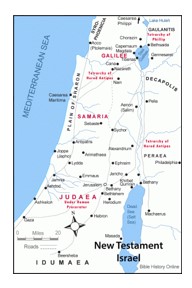
- The Macmillan Bible Atlas
- The Oxford Bible Atlas
HISTORY
- World History (Any good history book)
- Old Testament Bible History ‑ Edersheim
- The Life and Times of Jesus the Messiah ‑ Edersheim
- Josephus
COMMENTARIES
- Barnes’ O.T. & N.T.
- Speaker’s
- Pulpit
- Eerdman’s Bible Handbook
- Halley’s Bible Handbook
GENERAL
- Harper’s Encyclopedia of Bible Life
- Vine’s Expository Dictionary of Biblical Words
- Nave’s Topical Bible
- Treasury of Scriptural Knowledge
- Robertson’s “Harmony of the Gospels”, Harper-Row
Study Tools Summary:
Concordance:
- Helps to find passages, words, and phrases
- Study the words that are used in the original languages
Bible Dictionaries:
- Define times and gives background information on various topics
Bible Atlases:
- Develop geography, and links it to Biblical places & events
History Books:
- Give context of the era in which Biblical events take place
Commentaries:
- Give insights & opinions of others who have studied the Scriptures
A WORD OF WARNING
- Commentaries, dictionaries, encyclopedias, etc. are the work of uninspired men commenting about inspired scripture passages.
- Such reference books are very useful, but they should always be read carefully with an eye toward skepticism.
- Never place total confidence in the writings of uninspired men.
- Verify or disprove what they suggest for yourself, using the Scriptures.

| Versions of the Bible |
HISTORICAL DEVELOPMENT
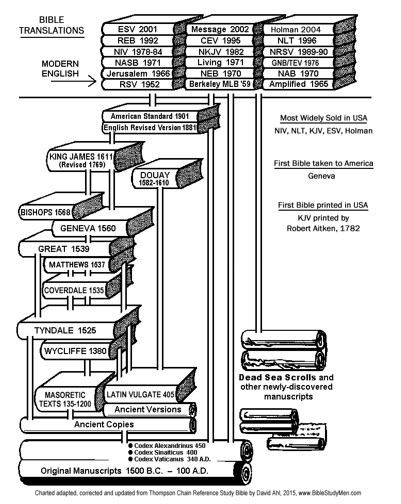
The chart below depicts the historical development of the Biblical Text.

RECEIVED TEXT & LATIN TEXT
Two distinct paths were followed in arriving at the modern translations which we have today.
The first path is that followed by the Catholic Church. It is predominately based on the Latin Vulgate translation of the Bible compiled by Jerome in approximately 382 A.D. It has roots in the Septuagint version of the Old Testament, written for the Jews in Alexandria, Egypt.
The second path is the Received Text or Traditional Text. It is derived from Hebrew manuscripts of the Old Testament and Greek manuscripts of the New Testament.
KING JAMES AUTHORIZED VERSION 1611
The most notable version translated from the Received Text path is the King James Version. It was produced in 1611 and has been one of the most influential versions ever written. It is still one of the most widely used versions today.
WESTCOTT & HORT TEXT ‑1870
They used Greek manuscripts, coupled with the theory of textual criticism. This resulted in the publication of the 1881 Revised Version, and it is from this version that the majority of the modern versions, including the NIV, are taken.
Translating the Bible
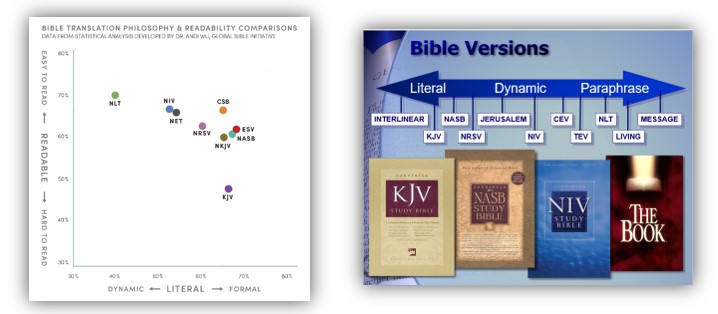
Some translations are very LITERAL – ‘word for word’, and are therefore more accurate to the original Hebrew and Greek texts. However, these translations are generally less ‘easy’ to read.
Examples of such are the KJV, NASB, RSV, and ESV.
Some are DYNAMIC – which means they practice ‘thought for thought’ to try and give the meaning of the original languages. This often makes for a much easier to read translation, but the accuracy may suffer.
Examples of such are the NIV, NRSV, and NJB
Some are PARAPHRASES – where the translator has put the text into his own words. This is the least accurate translation. A paraphrase often is easy to read, but doctrinal bias of the translator can lead to major doctrinal errors.
Examples of such are TLB, NLT, CEV, and MSG.
Most of us are dependent on scholars who are well versed in Hebrew and Greek. However, we must acknowledge that translators are human, and they, like the rest of us, are not able to come to the Bible free of all preconceived ideas. We believe the Bible to be wholly inspired by God (“God-breathed”) in its original languages, and to be completely without error, except due to translation errors or bias (unintentional or intentional).
We recall from the previous session on Tips on Reading, that it is helpful, when studying any passage in depth, to consult several versions. Most words in any language have more than one meaning. The meaning chosen by the translator will tend to be the one that fits his or her own preconceptions and traditions. Trying to translate so that the meaning is clear, the translator is influenced by his or her own beliefs and understandings.
WHICH TRANSLATION IS RIGHT FOR ME?
Each person is different, and as such, not all translations are good for the same person. It is recommended that for reading, a version be selected which is easy and comfortable for the individual. In addition to this, it is desirable to maintain a King James version for use in more detailed study. It provides important linkages to popular Lexicons and Concordances.
Here’s a worksheet if you want some ‘homework’… it’s downloadable too.
Go To: Study 5 – Mystery & The Jews and the Law of Moses

 The Original Gospel